How many words are in each HSK level?
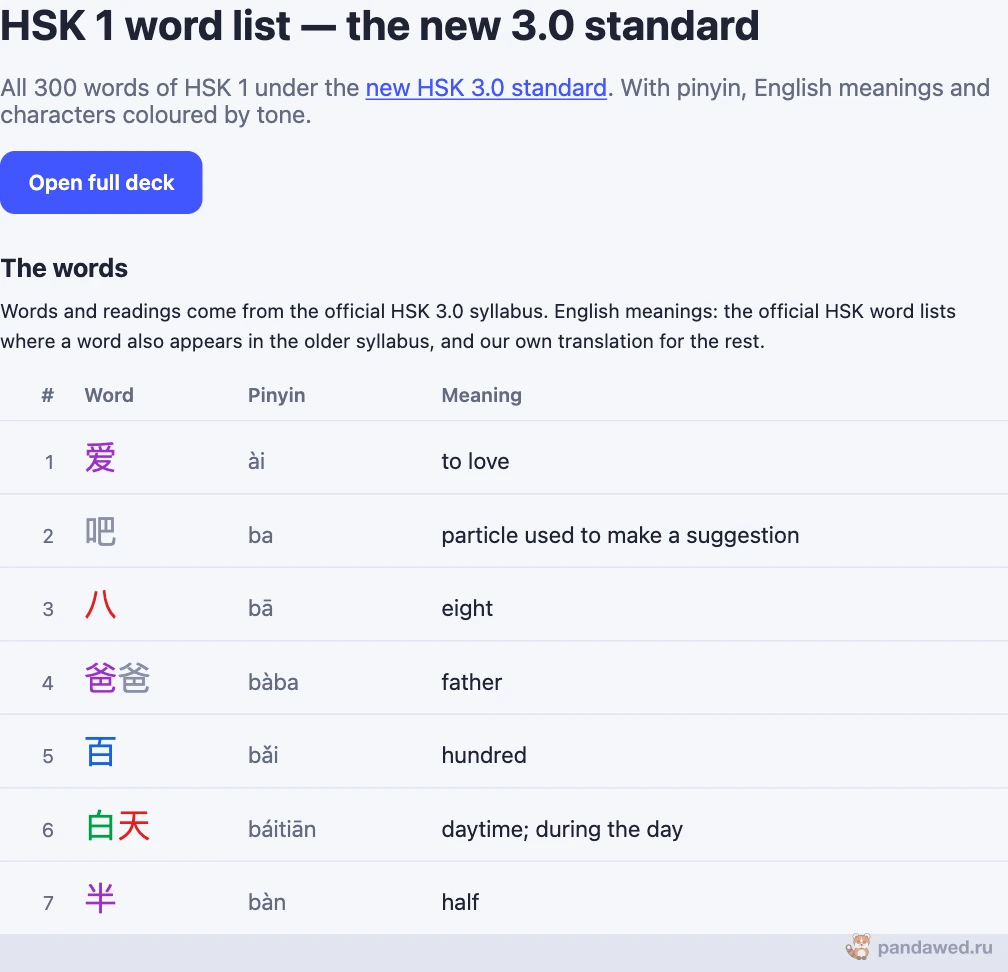
HSK 1 has 300 words in the new HSK 3.0 exam syllabus and 150 in the classic HSK 2.0 syllabus. By level 6, the totals are 5,400 and 5,000. The new syllabus goes further, reaching 11,000 words across nine levels. Which number should you use? Check the syllabus first, then look at how many words your next level adds.
First HSK 1 card · 爱 (ài) · Show meaning
HSK 3.0 vocabulary by level

The new exam syllabus, published in November 2025, divides the vocabulary into elementary, intermediate and advanced bands. The figures below refer to that exam syllabus. The broader 2021 proficiency grading standards use different figures, which is why you may also see 500 words quoted for a beginner’s level. When preparing for a particular sitting, check which syllabus your test centre will use.
Read across the HSK 3 row. A learner who has finished levels 1 and 2 already knows 500 words. Level 3 adds another 500, bringing the total to 1,000. Adding the totals down the column would count the beginner vocabulary several times.
| Level | New words | Total words | Band |
|---|---|---|---|
| HSK 1 | 300 | 300 | Elementary |
| HSK 2 | 200 | 500 | Elementary |
| HSK 3 | 500 | 1,000 | Elementary |
| HSK 4 | 1,000 | 2,000 | Intermediate |
| HSK 5 | 1,600 | 3,600 | Intermediate |
| HSK 6 | 1,800 | 5,400 | Intermediate |
| HSK 7–9 | 5,600 | 11,000 | Advanced |
Levels 7, 8 and 9 are assessed in one advanced exam. They share the final 5,600-word list. There is no separate level 8 vocabulary total to add on top of level 7.
How many Chinese characters appear at each level?

A vocabulary entry can contain two or three characters, and the same character can appear in dozens of words. To find out how many different shapes a learner will see, we counted the distinct Chinese characters in Pandawed’s HSK 3.0 vocabulary decks, keeping each character only the first time it appeared.
| Level | Total words | New characters | Total characters |
|---|---|---|---|
| HSK 1 | 300 | 248 | 248 |
| HSK 2 | 500 | 123 | 371 |
| HSK 3 | 1,000 | 284 | 655 |
| HSK 4 | 2,000 | 441 | 1,096 |
| HSK 5 | 3,600 | 431 | 1,527 |
| HSK 6 | 5,400 | 413 | 1,940 |
| HSK 7–9 | 11,000 | 1,148 | 3,088 |
Take 学 (xué, to learn). You meet it again in 学生 (xuésheng, student) and 学校 (xuéxiào, school). These are three vocabulary entries, but learning the latter two adds just two character shapes, 生 and 校, if you already know 学. See how familiar parts recur in our guide to Chinese radicals.
By level 6, 1,800 new words add 413 previously unseen characters. That ratio helps explain why an intermediate learner can read a new word in print yet still need to learn its meaning and pronunciation. The character counts measure exposure in these lists. They do not specify how many characters an exam candidate must write from memory.
HSK 2.0 vocabulary by level

The classic syllabus has six levels. Many textbooks and vocabulary apps still use this sequence. If you have just finished its 150-word beginner book, the next book introduces 150 more words. By the end of that second book, your total is 300. That explains why a deck labelled HSK 2 can legitimately have 150 cards.
| Level | New words | Total words |
|---|---|---|
| HSK 1 | 150 | 150 |
| HSK 2 | 150 | 300 |
| HSK 3 | 300 | 600 |
| HSK 4 | 600 | 1,200 |
| HSK 5 | 1,300 | 2,500 |
| HSK 6 | 2,500 | 5,000 |
If you are choosing between two similarly named decks, look for the syllabus badge as well as the level. The classic HSK 2 list has 150 new words. The HSK 3.0 level 2 list has 200. The difference changes what you will practise, even when both books say “level two” on the cover.
What counts as one word in HSK?
- A word can have several characters. 谢谢 (xièxie, thank you) counts as one entry. So does 火车站 (huǒchēzhàn, railway station), even though it takes three characters to write.
- One spelling can have two readings. In 很长 (hěn cháng, very long), 长 describes length. In 长大 (zhǎngdà, to grow up), the same shape has another pronunciation and meaning. A vocabulary list can distinguish the two readings.
- A fixed expression can be an entry. Learn 不客气 (bú kèqi, you’re welcome) as a reply you can give. You may already know its characters without recognising when someone would say the whole expression.
- Earlier levels stay in scope. An HSK 3 learner still needs the words taught at levels 1 and 2. When you open a deck containing only the new words, keep the earlier decks in your review schedule.
What can you do with this vocabulary?
Use these ranges to pick a task you want to try. The number of entries you recognise gives only part of the picture. Recognising a word in a list, catching it in a conversation and recalling it in time to answer are three different achievements.
- 300–500 words. Try introducing yourself, buying lunch or asking where the station is. Practise a follow-up question too. At a restaurant, asking for a price gets you only halfway if you cannot recognise the number in the reply.
- 1,000–2,000 words. Talk about your plans, explain what you study and read short messages. Reading a new message about a familiar subject is a good way to see which words you can recognise outside their original order.
- 3,600–5,400 words. Try a short news report or a work email on a subject you know. Notice which phrases recur. This helps you choose what to learn next when a topic uses specialised vocabulary.
- 11,000 words. The advanced list supports longer reading and discussion, including professional and academic subjects. Your own field will still have terms worth learning separately.
How many words should you learn per day?
Start with the number of new words left in your level. Divide it by the number you can learn on a study day, rounding up. For example, at ten words a day, the 200 new entries in HSK 3.0 level 2 take 20 study days to introduce. Allow another week for review and missed days, giving you about 27 days. If you already recognise half the deck, do the same calculation with the 100 entries you still need.
| HSK 3.0 level | New words | 5 per day | 10 per day | 20 per day |
|---|---|---|---|---|
| HSK 1 | 300 | 60 days | 30 days | 15 days |
| HSK 2 | 200 | 40 days | 20 days | 10 days |
| HSK 3 | 500 | 100 days | 50 days | 25 days |
| HSK 4 | 1,000 | 200 days | 100 days | 50 days |
| HSK 5 | 1,600 | 320 days | 160 days | 80 days |
| HSK 6 | 1,800 | 360 days | 180 days | 90 days |
The table counts first passes through the words. Add review time separately. As a planning allowance, set aside roughly one extra day for every three study days, then adjust after your first week. Ten new words that you can hear, recognise and use are a better daily target than twenty you keep forgetting the next morning.
For a first pass, read the character, say it, then uncover the meaning. On your next pass, work the other way around. If the English meaning comes easily but you cannot recall the Chinese word, keep the card among the words you are still learning. Choose your level in the HSK flashcard library.
Frequently asked questions
How many words are in HSK 1?
How many words are in HSK 4?
How many words are there across all nine HSK levels?
How many Chinese words do I need for a conversation?
How many characters are in HSK 1?
How many words are in HSK 3 and HSK 5?
Further reading
See how HSK 3.0 differs from HSK 2.0 for a closer look at the two syllabuses.