
Hello, thank you and goodbye in Chinese
You walk into your first Mandarin class. The teacher greets you with 你好, and you can answer with exactly the same two characters. A moment later, you turn to introduce yourself to the whole class. Now 大家好 makes more sense. Who is listening, and what happens next? Those two questions will take you further than memorising a single translation of “hello”.
15 polite phrases for everyday Mandarin
Use the right-hand column as a prompt. Imagine the situation, say the Chinese aloud, then check the characters and pinyin. For a first practice session, pick one greeting, one reply and one farewell.
| Mandarin | Pinyin | When to use it |
|---|---|---|
| 你好 | nǐ hǎo | Hello, when meeting one person. |
| 您好 | nín hǎo | A respectful hello to a guest, customer or older person. |
| 大家好 | dàjiā hǎo | Hello everyone, when addressing a group. |
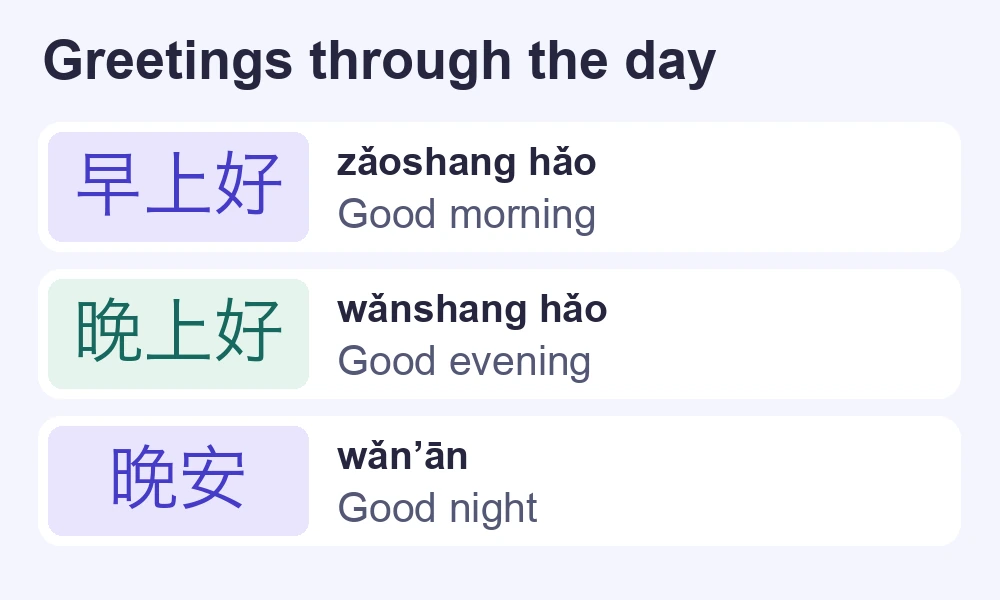
| 早上好 | zǎoshang hǎo | Good morning, when you arrive. |
| 晚上好 | wǎnshang hǎo | Good evening, when you meet. |
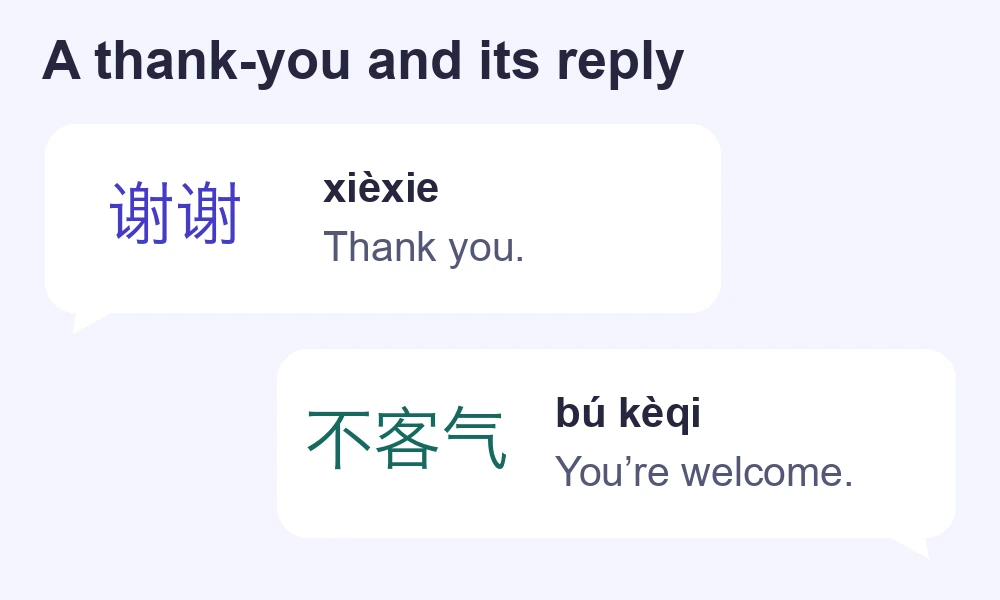
| 谢谢 | xièxie | Thank you, for a favour or a service. |
| 不客气 | bú kèqi | You’re welcome, in reply to thanks. |
| 请 | qǐng | Please, when inviting someone to do something. |
| 对不起 | duìbuqǐ | I’m sorry, when you owe an apology. |
| 不好意思 | bù hǎoyìsi | Excuse me, when interrupting or squeezing past. |
| 没关系 | méi guānxi | That’s all right, in reply to an apology. |
| 请问 | qǐngwèn | Excuse me, may I ask…? Use it before a question. |
| 再见 | zàijiàn | Goodbye, when leaving. |
| 拜拜 | bàibai | Bye, at the end of a casual chat. |
| 晚安 | wǎn’ān | Good night, when someone is going to bed. |
How to say hello in Chinese
你好 combines 你, “you”, with 好, “good”. Together they make a greeting. If a shopkeeper says 你好 as you enter, a smile and 你好 are a complete reply. You can use the same greeting to get someone’s attention at a counter. With a close friend you might simply call their name or say 嗨 (hāi).
There is a small difference between the pinyin you see on a page and the tones you hear. Both 你 and 好 have a third tone in isolation. In 你好, the first syllable rises like a second tone because another third tone follows. Dictionaries usually keep the underlying tones and write nǐ hǎo. Try saying the greeting as one unit, rather than pausing between the characters.
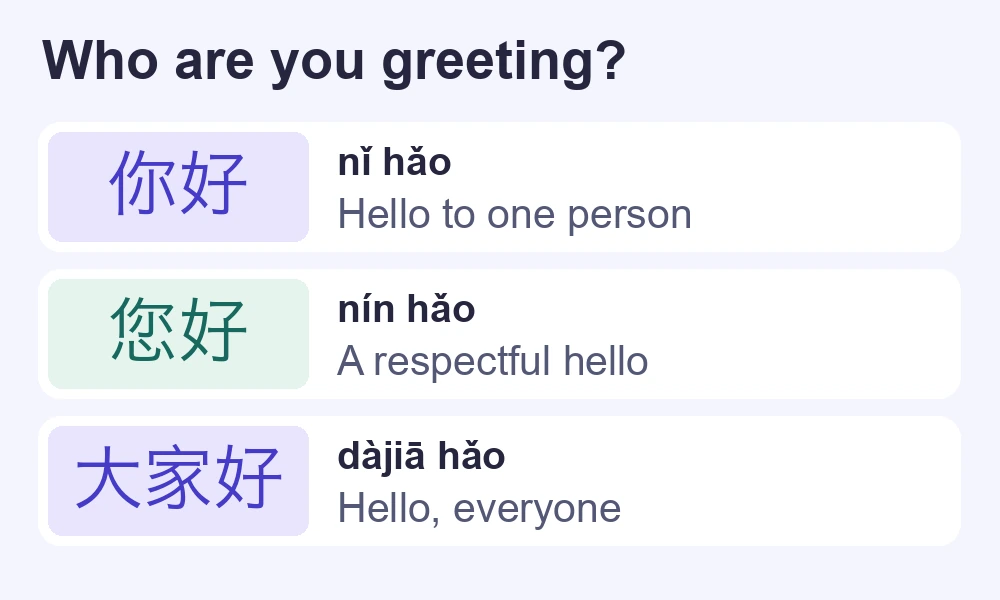
您 (nín) addresses one person respectfully. In a group, 大家 means “everyone”; 你们好 (nǐmen hǎo) also works when speaking to several people. If you know your teacher’s family name, 王老师好 (Wáng lǎoshī hǎo), “Hello, Teacher Wang”, is a warm way to greet them. Look closely at 您 and you can see 心 at the bottom. The guide to recognising Chinese radicals shows how to spot recurring shapes like this in unfamiliar characters.
Good morning, good evening and good night
At the start of the day, 早上好 is a full “good morning”. A colleague walking past your desk might shorten it to a cheerful 早 (zǎo). In the evening, say 晚上好 when you meet someone. Save 晚安 for the moment you wish someone a good night, for example when ending a late call before bed.
What about 你好吗 (nǐ hǎo ma), “How are you?” It is a grammatical question, but a passing 你好 usually calls for a greeting in return. When catching up with someone you know, 最近怎么样 (zuìjìn zěnmeyàng), “How have things been lately?”, opens a real conversation. Around mealtime you may also hear 吃了吗 (chī le ma), “Have you eaten?” Between neighbours this can be a friendly greeting. The context tells you whether someone is actually offering food.
How to say thank you and you’re welcome
A classmate holds the door. You say 谢谢 (xièxie); they reply 不客气 (bú kèqi). Listen for the short, light second syllable in 谢谢. In 不客气, 不 is pronounced with a rising tone before the fourth tone of 客. For a particular favour you can name it directly: 谢谢你的帮助 (xièxie nǐ de bāngzhù) means “Thank you for your help”. A more emphatic option is 非常感谢 (fēicháng gǎnxiè), “Thank you very much”.
请 (qǐng) does a different job. Put it before an action when asking someone to do something: 请坐 (qǐng zuò), “Please take a seat”, or 请进 (qǐng jìn), “Please come in”. Imagine opening your door to a visitor. You say 请进 while they are standing on the doorstep. If they thank you as they come inside, your next line can be 不客气.
Excuse me or I’m sorry?
Choose a phrase by deciding what you need from the other person. To ask for directions, open with 请问. To interrupt someone or edge past them on a crowded bus, 不好意思 acknowledges the small inconvenience. If you step on someone’s foot or keep a friend waiting, 对不起 is a direct apology. The other person can say 没关系 to reassure you.
At a station
请问,洗手间在哪儿? (Qǐngwèn, xǐshǒujiān zài nǎr?) — “Excuse me, where is the restroom?”
在左边。 (Zài zuǒbian.) — “On the left.”
谢谢! — “Thank you!”
Arriving late for class
老师,对不起,我迟到了。 (Lǎoshī, duìbuqǐ, wǒ chídào le.) — “I’m sorry I’m late.”
没关系,请坐。 (Méi guānxi, qǐng zuò.) — “That’s all right. Take a seat.”
Notice how 请问 prepares the listener for the question that follows. If you have already asked once and missed the answer, try 不好意思,请再说一遍 (bù hǎoyìsi, qǐng zài shuō yí biàn), “Sorry, please say that again”. It gives the listener a much clearer cue than repeating “excuse me”.
Goodbye, see you tomorrow and take care
再见 fits the end of a lesson, a shop visit or a phone call. You can borrow the pattern with 见, “see”, to say when you expect to meet again. 明天见 (míngtiān jiàn) is “See you tomorrow”; 下周见 (xià zhōu jiàn) is “See you next week”. If you make no particular plan, 回头见 (huítóu jiàn) is a casual “See you later”. Among friends, 拜拜 is another easy goodbye.
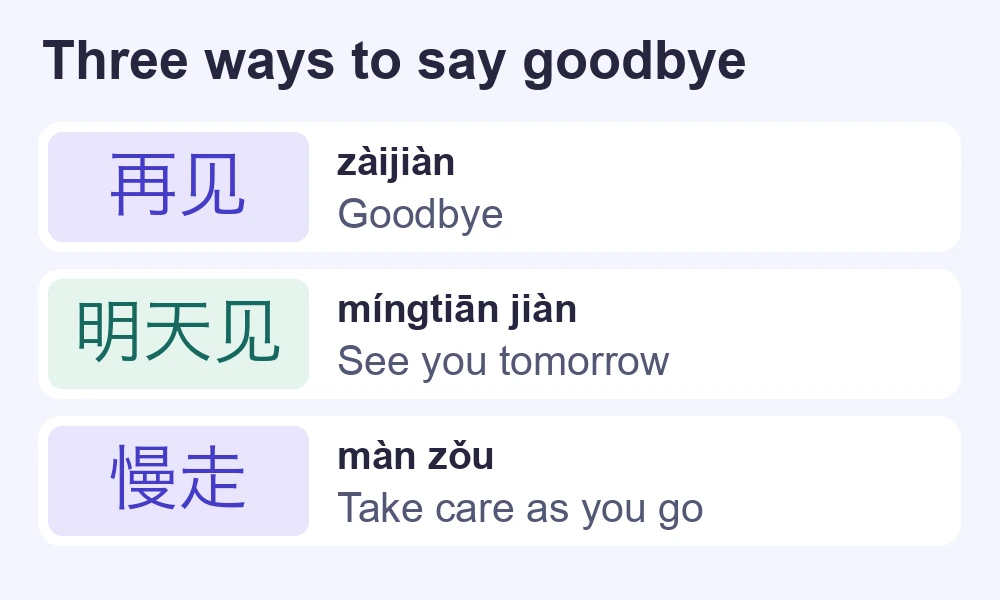
慢走 (màn zǒu) literally asks someone to “walk slowly”. Said by a host at the door, it sends the guest off with care. If you are the guest, say goodbye normally. Reversing the roles and saying 慢走 to the person staying home would sound odd.
Introducing yourself in person or by message
After the first hello, 我叫… (wǒ jiào…) gives your name. 你叫什么名字? (Nǐ jiào shénme míngzi?) asks for the other person’s name. In a formal introduction you can ask 您贵姓? (Nín guìxìng?), “May I ask your surname?” A reply might be 我姓王 (wǒ xìng Wáng), “My surname is Wang”. If this person teaches your class, you can then address them as 王老师. Chinese family names usually come before given names.
先生 (xiānsheng) and 女士 (nǚshì) occur in formal forms of address. 师傅 (shīfu) may be used for a driver or a skilled tradesperson. 阿姨 (āyí) and 叔叔 (shūshu) can express familiarity with someone a generation older; their effect depends on the relationship. If you just want to catch a shop assistant’s attention, 你好 is a simple choice. 很高兴认识你 (hěn gāoxìng rènshi nǐ), “Nice to meet you”, rounds off an introduction.
In a message, give the reader something they can answer. For example, 王老师,您好!请问明天几点上课? means “Hello, Teacher Wang! What time is class tomorrow?” It is easier to act on than a lone 在吗 (zài ma), “Are you there?” When a teacher sends the time, 收到,谢谢! (Shōudào, xièxie!) acknowledges receipt. To agree to a plan, 好的 (hǎo de) means “Okay”. 麻烦你了 (máfan nǐ le) acknowledges the trouble someone is taking; 辛苦了 (xīnkǔ le) recognises the effort they have already put in.
Practise a whole exchange
Close the table and imagine three moments in one visit: arriving at your teacher’s house, taking the seat they offer, then leaving with plans to meet tomorrow. Say one line for the visitor and one for the host at each point. Open the table to check whichever line was hardest to recall. Next time switch to a shop or a railway station so the same phrases have a new setting.
If your class uses the older syllabus, the classic HSK 1 word list with English meanings matches that edition. For a class that follows the newer syllabus, use the guide to the HSK 3.0 standard to pick the right material. For your next practice session, choose a Chinese–English flashcard deck.
Frequently asked questions
How do I reply when someone says 你好?
你好 is a complete reply. If it is your teacher, you can greet them with 老师好. If you are introducing yourself to an entire class, start with 大家好 and follow it with your name.
What can I say after 谢谢?
不客气 is a useful everyday choice. 不用谢 (bú yòng xiè), “No need to thank me”, also works. With someone you know well, 没事 (méi shì), “No problem”, can sound more casual.
Is 晚安 a way to say hello in the evening?
晚上好 greets someone in the evening. 晚安 wishes them a good night as you part or finish talking before bed.
Which word for “excuse me” should I learn first?
For travel, learn 请问 with an actual question, such as 请问,车站在哪儿? (“Excuse me, where is the station?”). Then learn 不好意思 for situations where you need to interrupt or get past someone.